Local search for pharmacies: found
by their towns, on Google and in AI.
Two community pharmacies, one in Great Yarmouth and one in Wales, faced the same quiet problem: patients nearby could not find them at the moment of need. This is how one repeatable playbook fixed both, and why local search now has two audiences instead of one.
Trusted at the counter,
invisible at the moment of need
Pharmacy Exprezz serves Great Yarmouth and Central Pharmacy serves its community in Wales. Both are trusted in person, and both were losing the moments that matter online: the patient searching pharmacy near me at nine in the evening, the parent asking a phone assistant where to get a prescription filled, the visitor checking opening hours before setting out.
Their situations differed in detail, Exprezz needed its product experience rescued while Central needed a ground-up rebuild, but the underlying problem was the same. Their websites were written for people who had already found them, not for the searches and questions through which new patients arrive.
Three problems,
stated plainly
We write the problems down before we design anything. If a proposed solution does not answer at least one of them directly, it does not make the build.
Not the answer to near me
When nearby patients searched for a pharmacy or a service, these businesses did not reliably appear. In local healthcare, not appearing is indistinguishable from not existing, because patients act on the first trustworthy answer they get.
Pages that fought the patient
Patients arrive on phones, often unwell or hurried. Cluttered product pages, buried prices, and unclear next steps turned simple tasks into work, and every extra tap sent someone to a competitor or a delay in care.
Invisible to the new front door
Discovery increasingly happens through AI assistants that answer where should I go directly. Sites without structured, accurate information about services, hours, and location cannot be read by these systems, which means they are absent from a growing share of all local recommendations.
Qualifying solutions
before applying them
We began with how patients actually search: on mobile, in the moment, with location words and service words, and increasingly by asking an assistant a full question rather than typing keywords. We audited both sites against those real journeys, from the search result to the completed task, and recorded where each one lost the patient.
Both sets of stakeholders were part of the research, because the pharmacists live with the result. What must never be wrong, hours, location, and services, became the accuracy backbone of both builds, and what patients ask at the counter shaped what the sites answer first.
Every solution was qualified against the same tests before adoption: does it make the pharmacy the accurate answer for both search engines and AI assistants, does it shorten the patient’s path on a phone, and can the pharmacy team keep it current without technical help. Work that could not pass all three did not make either build.
One playbook,
applied twice
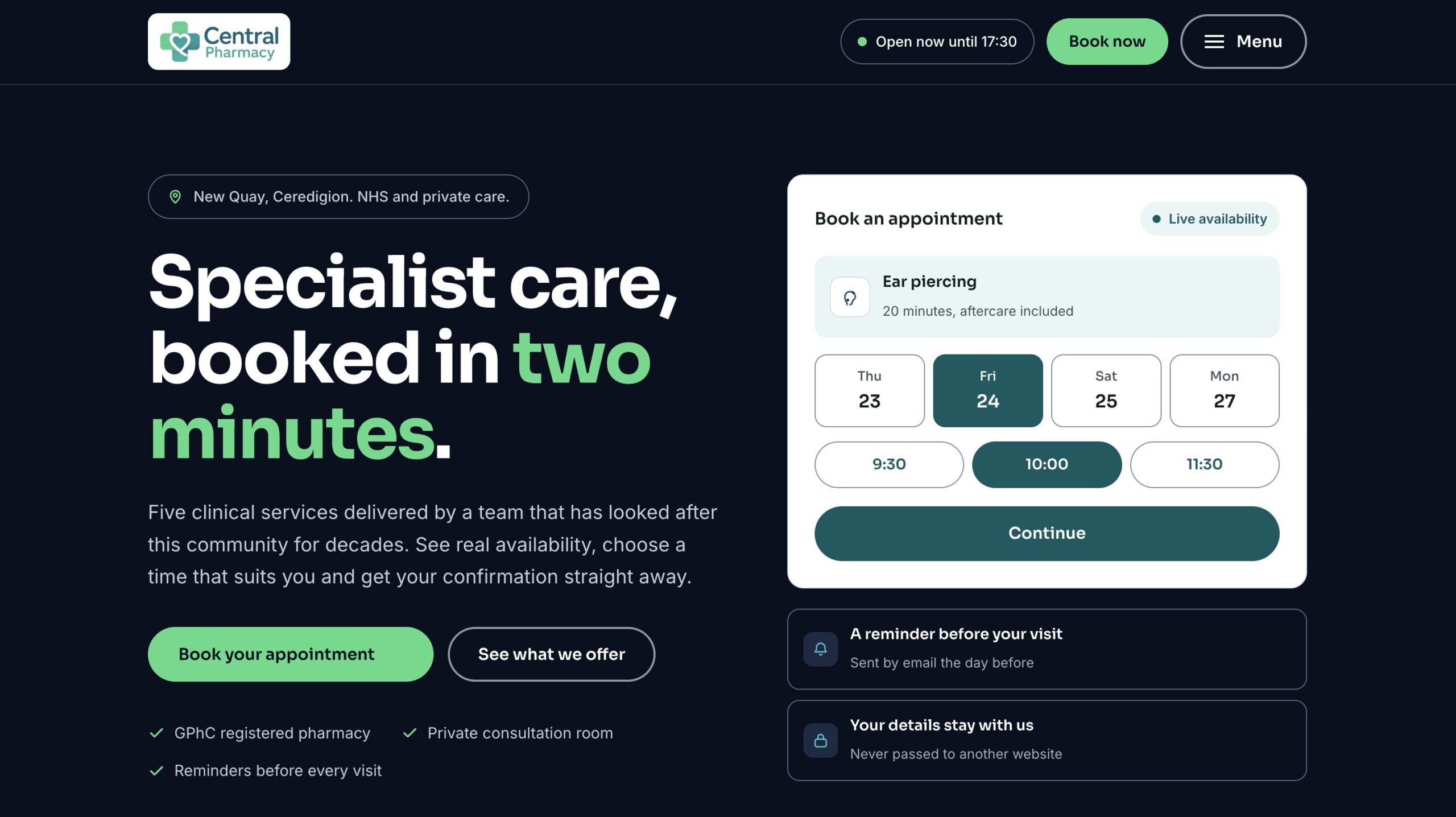
For Pharmacy Exprezz, we redesigned the product experience around the way patients shop: clear names, visible prices, and an obvious next step on every product, mobile first. For Central Pharmacy, we rebuilt the entire site with a modern, accessible design and plain language a patient of any age can follow.
Beneath both, the same local search groundwork: services, products, opening hours, and locations structured so search engines and AI assistants read them accurately. That is GEO in practice, generative engine optimisation, which simply means being the answer the machines give when a nearby patient asks. Because the playbook is repeatable, the second engagement moved faster than the first, and the next one will move faster still.
What changed,
and what it means
Both pharmacies now surface when their towns search, and the pages patients land on respect their time and their state of mind. The before and after comparisons tell the visual story, but the operational one matters as much: both teams can keep their own information current, so the accuracy that machines and patients depend on does not decay after launch.

What this project teaches
beyond this project
These are the four lessons we would put in front of any business owner or stakeholder facing a similar challenge.
1. Local search now has two audiences
The search engine and the AI assistant both stand between a local business and its customers, and they read differently. Structuring information for machines while writing it for humans is no longer advanced practice, it is the baseline for being found. A business optimised for only one of the two is invisible to a growing share of its market.
2. For local businesses, accuracy beats cleverness
No headline outperforms correct opening hours. The information patients and machines check first, hours, location, services, is the least glamorous content on the site and the most commercially important. Build the accuracy backbone first and make it effortless for the business to maintain, because stale information destroys trust twice, once with the customer and once with the machine.
3. Design for the customer’s worst moment
Pharmacy patients are often unwell, stressed, or hurried, and every business has an equivalent worst moment. Designing for that state, fewer taps, plainer words, obvious next steps, serves every other visitor automatically. Usability tested against a calm desktop user is usability untested.
4. Solve it twice and you have a playbook
The second pharmacy proved the approach was repeatable, not bespoke. When a transformation is built as a playbook, qualification criteria, structure, and process, each subsequent client gets a faster, cheaper, more reliable result. Stakeholders should ask any agency not just what they built, but what they can now repeat.
Search for your business
the way a stranger would.
Try near me, and try asking an AI assistant. If you are not the answer, your customers are being sent elsewhere at the exact moment they need you. Tell us your business and your town and we will show you where you stand.
No commitment · Responds within 24 hours · London GMT · Global projects welcome