Zurich Insurance: consumer AR
for vehicle protection products.
Insurance is a product nobody can see, sold at a moment when attention is elsewhere. This is how focus-group-validated augmented reality made vehicle protection tangible at the point of sale, earned genuine consumer engagement, and carried the case to the CIO conclave.
An invisible product,
a distracted moment
Vehicle protection products face a double disadvantage at the point of sale. The product itself is invisible, a promise about hypothetical futures, and it is offered at exactly the moment the customer’s attention belongs to something far more exciting: the vehicle. Coverage explained in paragraphs competes with paintwork, and loses.
Zurich engaged us to explore whether augmented reality could change that equation, making protection something a customer could see on the vehicle in front of them, and doing it credibly enough to survive the scrutiny a global insurer rightly applies to anything touching its brand.
Three problems,
stated plainly
We write the problems down before we design anything. If a proposed solution does not answer at least one of them directly, it does not make the build.
Protection could not be seen
Insurance is words about possibilities, and words about possibilities are the weakest sales material at a physical point of sale. Customers could not picture what was covered, so the product registered as paperwork rather than value.
Attention belonged to the vehicle
The point of sale is emotionally dominated by the purchase itself. Any protection experience that demanded sustained reading or patience was competing with the car for attention, and no leaflet has ever won that contest.
AR had to earn its place with evidence
Enterprise innovation fails two ways: consumers ignore it, or the organisation never adopts it. The concept needed validated consumer appeal before serious build, and a case strong enough to convince senior technology leadership afterwards.
Qualifying solutions
before applying them
We validated with real consumers before committing to build, testing AR concepts in focus groups to learn what genuinely engaged people rather than what merely demonstrated well. Focus group evidence shaped the experience iteratively: concepts were refined, retested, and qualified by consumer reaction, not by internal enthusiasm.
The research drew a line that guided the design throughout: engagement had to come from usefulness made delightful, showing a customer their coverage on their vehicle, rather than from technology performing for its own sake. Novelty earns a first glance, but only utility earns attention at a point of sale.
We treated the enterprise as a second audience with its own journey. A global insurer adopts innovation through governance, evidence, and internal advocacy, so the work was delivered with enterprise-grade project management and built into a case senior stakeholders could evaluate and champion.
Make the coverage visible
on the vehicle itself
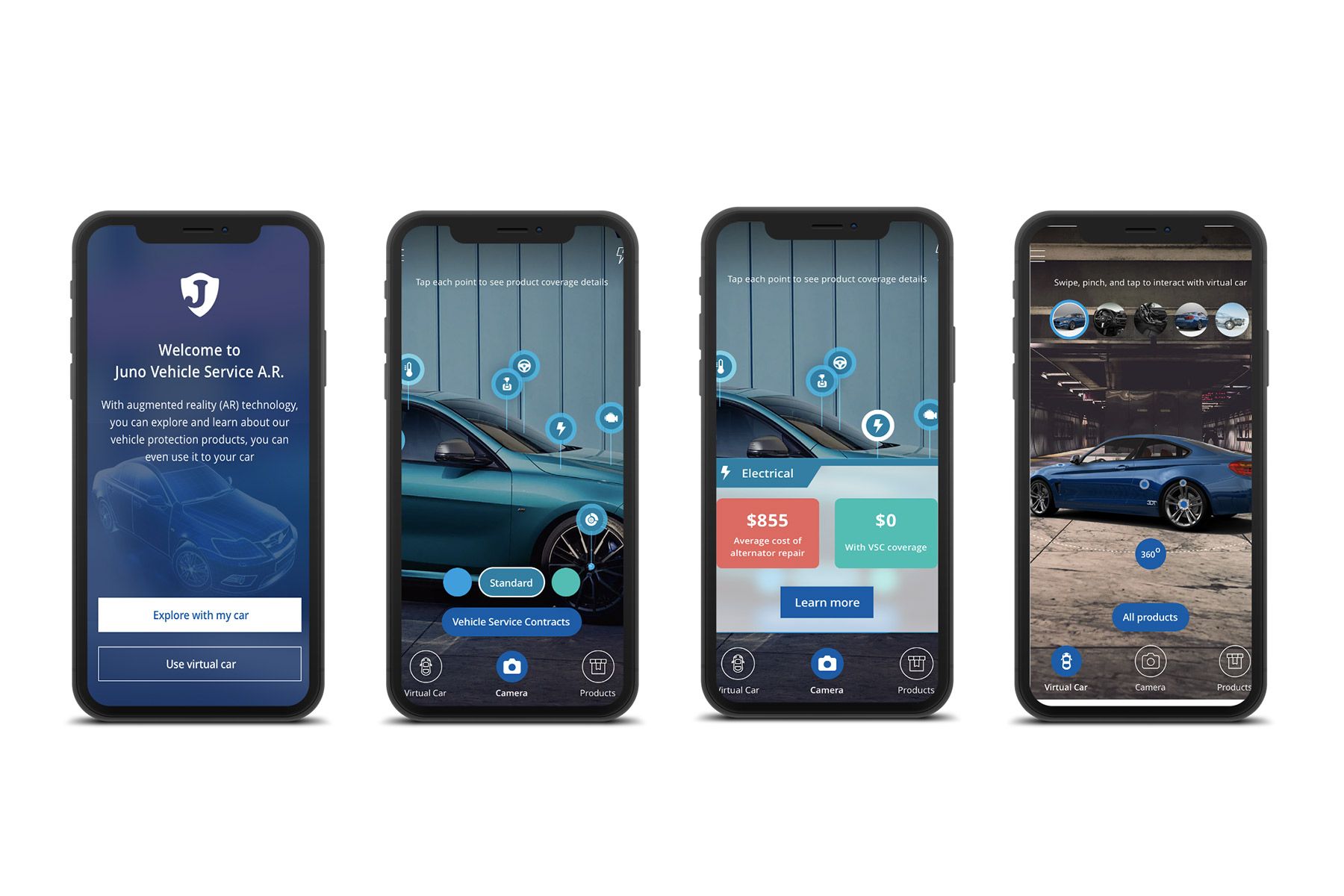
The experience uses augmented reality to make protection tangible: customers see coverage represented directly on the vehicle in front of them, turning an abstract promise into something concrete at the exact moment of decision. The interaction is quick, intuitive, and designed for a showroom’s rhythm rather than a laboratory’s patience.
Every element was validated through the focus group cycles before it earned its place, and the delivery was managed to the standard a global insurer requires. The result was carried beyond the project itself and presented to the CIO conclave, taking validated consumer innovation to the organisation’s senior technology leadership.
What changed,
and what it means
The experience earned genuine consumer engagement at the point of sale, validated by focus groups rather than assumed, and made an invisible product visible at the moment it is bought. Its presentation to the CIO conclave marked the outcome enterprise innovation most often misses: consumer-proven work reaching the leadership able to scale it.
What this project teaches
beyond this project
These are the four lessons we would put in front of any business owner or stakeholder facing a similar challenge.
1. Make the invisible product visible
Insurance, warranties, subscriptions, and services all sell promises the customer cannot see. Whatever makes the promise concrete, visualisation, simulation, or demonstration, converts better than description, because people buy what they can picture. Ask what your customer would see if your product were visible, then build that.
2. Validate with consumers before you commit the budget
Focus groups before build are cheaper than launches that flop. Testing concepts with real consumers, and letting their reactions redesign the work, is the discipline that separates innovation from expensive theatre. Enthusiasm inside the building is not evidence.
3. Innovation needs a boardroom journey too
Consumer-facing work that never convinces internal leadership dies in pilot. Treating the enterprise as a second audience, with its own evidence, governance, and advocates, is what carried this work to the CIO conclave. Plan the internal journey with the same care as the customer one.
4. Utility earns the attention that novelty only borrows
New technology draws a glance, and a glance is all it draws unless the experience is genuinely useful. Anchoring AR to a real customer question, what exactly am I protected for, is why engagement was real rather than polite. Lead with the usefulness and let the technology be how, not why.
Selling something your
customer cannot see?
Intangible products lose at distracted moments unless something makes them concrete. Tell us what you sell and where attention goes instead, and we will show you how to make the invisible visible.
No commitment · Responds within 24 hours · London GMT · Global projects welcome