Women’s Green Bank: a digital platform
for financial inclusion.
One platform, two audiences that could hardly be more different: international funders assessing credibility, and the market women of Sierra Leone’s informal economy the bank exists to serve. This is how both were served from one home, and what it teaches about designing across worlds.
A bank being built
for two worlds
Women’s Green Bank is being built for the women who power Sierra Leone’s informal economy: market traders, producers, and entrepreneurs whose work sustains communities but rarely earns access to financial tools. Its promise is access and dignity.
To deliver that promise, the organisation must convince two audiences with opposite expectations. International funders and development finance institutions assess governance, data, and credibility before committing support. The women the bank serves need to feel, within seconds and on a basic phone, that this institution is genuinely for them. Most platforms pick one audience and quietly fail the other.
Three problems,
stated plainly
We write the problems down before we design anything. If a proposed solution does not answer at least one of them directly, it does not make the build.
Funders needed institutional proof
Development finance moves on evidence: governance, mission clarity, and professional presentation. A platform that read as informal would close funding doors before a conversation began, however worthy the mission.
The community arrives on basic phones
The women the bank serves often have limited digital literacy, older devices, and data that costs real money. Heavy pages, dense text, and institutional jargon do not just inconvenience this audience, they exclude it, which for an inclusion bank is failure by definition.
Serving either audience risked alienating the other
Content formal enough for funders could feel cold to the community. Content warm enough for the community could read as lightweight to funders. The platform had to hold both registers without splitting into two disconnected sites.
Qualifying solutions
before applying them
We researched each world on its own terms. For funders, we studied what development finance institutions actually look for when assessing a partner organisation, and where credibility is won or lost in a first visit. For the community, we grounded the design in the realities of access: the devices in use, the cost of data, the languages spoken, and the level of digital confidence a first-time visitor brings.
The research produced the platform’s central design decision before a page was built: this is one organisation with two content layers, not two messages wearing one logo. User experience had to be engineered for both, because a funder’s thirty-second credibility scan and a market trader’s first tap on a borrowed phone are both user experiences, and the platform lives or dies on each.
Every solution was qualified against both audiences at once: pages had to stay light enough for slow connections and modest data budgets, content had to work bilingually, imagery had to show the real women and businesses being served, and the institutional layer had to present governance and mission with the rigour funders expect. Anything that served one audience at the other’s expense was rejected.
Institutional upstairs,
human at the door
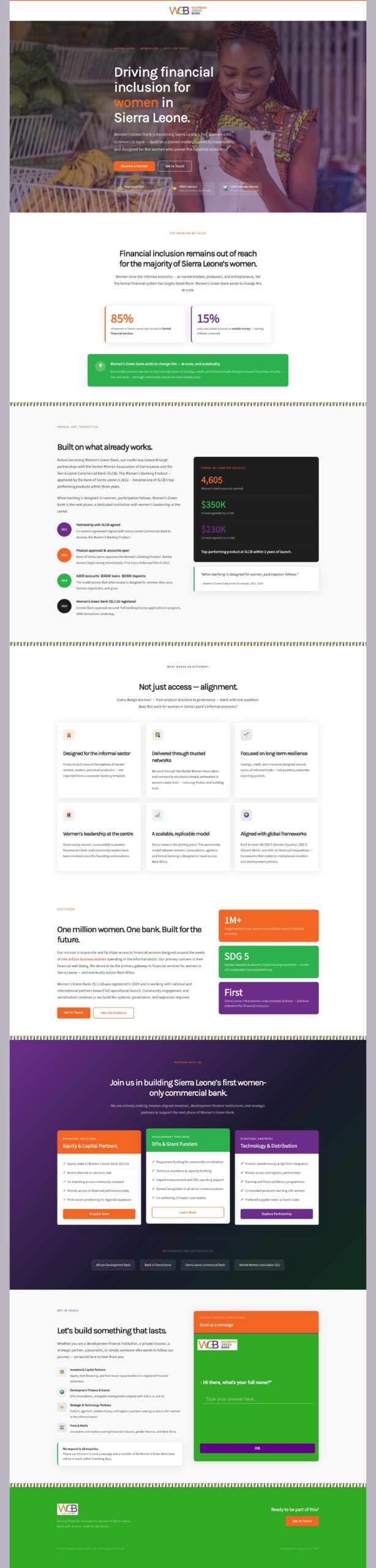
The platform presents two clearly differentiated layers sharing one identity. The institutional layer carries the mission, governance, and financial inclusion case with the clarity and professionalism funders assess. The community layer speaks simply and warmly, led by photography of the real women and businesses the bank serves, in language written for reading contexts the sector usually ignores.
The build is mobile-first and deliberately light, because that is how its most important audience arrives. Donation and partnership journeys are woven through, so a funder and a supporter can each act without friction, and the whole platform works in the languages of the people it serves.
What changed,
and what it means
The platform earns trust with international funders while genuinely connecting with the women it exists to serve, bridging two worlds from one digital home. It stands as working proof that institutional credibility and grassroots accessibility are not opposites, they are two user experiences designed with equal seriousness.
What this project teaches
beyond this project
These are the four lessons we would put in front of any business owner or stakeholder facing a similar challenge.
1. Credibility and accessibility are not a trade-off
The assumption that professional means formal and accessible means lightweight fails both audiences. Credibility comes from clarity, evidence, and coherence, and all three survive plain language perfectly well. The organisations that serve two worlds best refuse the trade-off entirely.
2. Data cost is a design constraint, not a technical detail
When your audience pays for every megabyte, page weight is an ethical decision. Designing light is not a performance optimisation, it is the difference between including people and charging them admission. Any organisation serving low-income users should put data budget beside colour palette in the design brief.
3. Show your audience to your audience
The fastest way to tell the market women of Sierra Leone that this bank is for them was photography of women like them, doing work like theirs. Representation in imagery is not decoration, it is the trust signal that arrives before a single word is read.
4. Write the institutional layer as conversion content
Governance pages and mission statements are usually treated as obligations. For funder audiences they are the conversion journey: the pages where support is decided. Treating them with the care normally reserved for a homepage is what turns credibility into commitment.
Reaching worlds that
speak different languages?
Funders and beneficiaries, institutions and individuals, experts and first-timers. One platform can hold them all when both experiences are designed with equal seriousness. Tell us who you need to reach and we will show you how.
No commitment · Responds within 24 hours · London GMT · Global projects welcome