White Glove Cleaning: the booking system that ended the diary headache.
For most service businesses, the product is fine and the diary is the problem. This is the story of how a Southampton cleaning company replaced a diary run on phone calls and memory with a calendar-linked booking system, and what any business that books appointments can take from it.
The product was never
the problem
White Glove Cleaning Services delivers premium cleaning across Southampton, and the reviews say the cleaning itself was never in question. The operation around it was another matter. Bookings arrived by phone and message, availability lived in people’s heads, and the calendar was reconstructed daily from scattered conversations.
The consequences were predictable and expensive. Slots were double-booked, appointments were missed, and cleaners cancelled jobs that clashed with one another. Each incident cost money directly and goodwill indirectly, and the office spent hours every week doing the coordination work a system should do.
Three problems,
stated plainly
We write the problems down before we design anything. If a proposed solution does not answer at least one of them directly, it does not make the build.
Nobody could see the whole week
Availability lived in conversations and heads rather than in one place anyone could check. Without a single view of the week, every booking was a guess about what else had been promised, and clashes were a matter of time rather than chance.
Clashes cost jobs and goodwill
When two bookings landed on the same slot, someone lost: a customer was let down or a cleaner cancelled. Every clash cost real revenue and quietly taught customers not to rely on the diary.
Coordination consumed the week
The office spent hours confirming, rearranging, and reminding by hand. That time produced no revenue and grew with every new customer, which meant growth made the business harder to run.
Qualifying solutions
before applying them
We began inside the operation, not with software. We followed real bookings from first enquiry to finished job, sat with the office through a scheduling day, and spoke with the cleaners about why cancellations actually happen. The pattern was clear: everyone was acting sensibly on incomplete information, because there was no single place where the truth of the week lived.
We also treated the system as having two user groups, not one. Customers needed booking to feel effortless. The office and the cleaners needed a diary they could read at a glance and trust completely, because user experience and good ergonomics matter as much behind the counter as in front of it.
Solutions were qualified against clear criteria before anything was adopted: availability shown to customers had to be genuinely live, an overlap had to be impossible rather than unlikely, the diary had to be readable by a non-technical team in seconds, and confirmations and reminders had to run without anyone typing them.
Make availability self-serve,
and clashes impossible
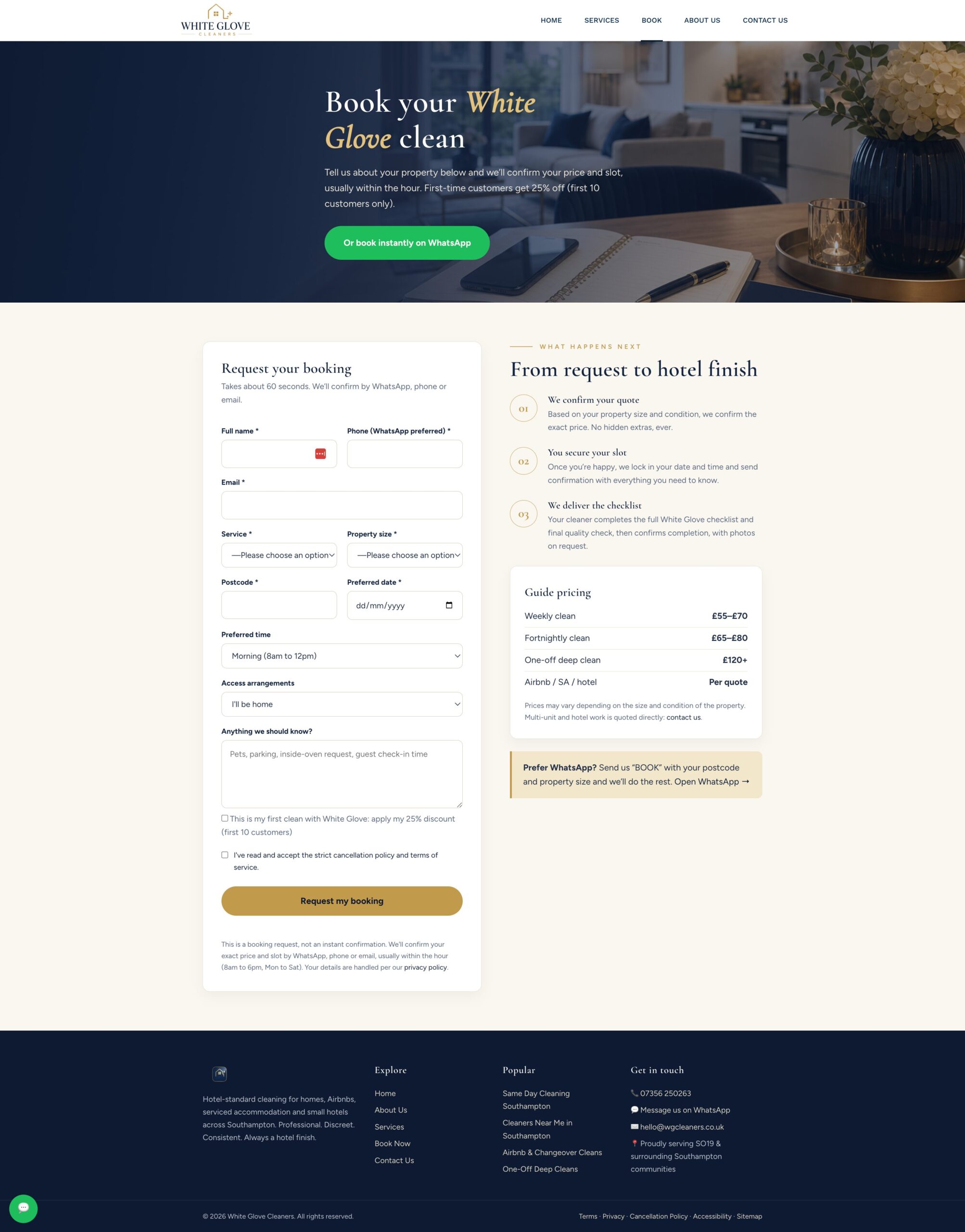
The heart of the build is a calendar-linked booking system inside a clean, welcoming website. Customers choose a service, see genuine live availability, and confirm a slot in a couple of taps. Instant confirmation follows automatically, and the calendar closes that slot everywhere the moment it is booked, so an overlap cannot be created by anyone, including the business itself.
The team side received equal design attention. The office sees the week on one screen, changes ripple everywhere instantly, and cleaners work from a schedule that is finally dependable. The consultancy part of the engagement mattered as much as the build: we worked with the team to reshape the booking process around the system, so old habits did not quietly recreate the old chaos.
What changed,
and what it means
Double bookings are gone by design rather than by vigilance. Cancellations from providers have fallen because the clashes that caused them no longer occur. Customers book at any hour and trust the confirmation, and hours of coordination time have come back to the business every week, time that now goes into the work customers pay for.
What this project teaches
beyond this project
These are the four lessons we would put in front of any business owner or stakeholder facing a similar challenge.
1. If your diary is a conversation, it is a liability
A diary that lives in phone calls and memory fails in proportion to how busy you get, which means it fails exactly when the business is winning. Making availability self-serve is the single highest-value move for most appointment businesses, because it removes the coordination bottleneck and the human error in one step.
2. A booking is a promise, so only show what you can keep
Customers do not distinguish between a system error and a broken promise. Showing genuinely live availability, and making overlaps structurally impossible, means the business only ever promises what it can deliver. Reliability is not a customer service skill, it is a system property.
3. Change the process with the people, not just the software
Software alone does not transform anything. The consultancy work, sitting with the team, mapping the booking journey, and reshaping habits around the new system, is what made the change stick. If the people who run the diary were not part of designing it, expect them to work around it.
4. Won-back admin time is the quiet return on investment
The visible wins are the ended clashes, but the compounding one is time. Hours a week returned to a small team is the equivalent of new capacity without a new hire, and unlike a marketing spend, it repeats every week from launch onward.
Which slot is your diary
double-booking right now?
If bookings live in phone calls and someone’s memory, the next clash is already scheduled. Tell us how your appointments work today and we will show you what a calendar-linked system could hand back.
No commitment · Responds within 24 hours · London GMT · Global projects welcome