Golden Threads: one home for books,
music, and a growing readership.
When your products sell on Amazon, your music streams on Spotify, and your audience lives on Substack and socials, the question is not which channel to choose. It is where they all meet. This is how a children’s book series got its centre, and what any multichannel brand can learn from it.
A series that lived
everywhere and nowhere
Golden Threads of Inspiration is a series of illustrated children’s stories by Walé Akíngbadé, rooted in African folklore and exploring themes like identity, patience, and resilience, with an original musical score composed for every title. Families love it and teachers recommend it, which is the hard part done.
Distribution was the puzzle. The books sell on Amazon in paperback and hardcover, the music streams on Spotify and other platforms, exclusive stories reach readers through Substack, and the audience gathers across half a dozen social channels. Each channel worked, but nothing connected them, and a reader discovering the series through any one door had no way to see the world behind it.
Three problems,
stated plainly
We write the problems down before we design anything. If a proposed solution does not answer at least one of them directly, it does not make the build.
Every channel was a dead end
A parent finding a book on Amazon never learned there was a soundtrack. A listener finding the music never learned there were books. Each platform showed its own slice and kept its audience, so the series was permanently introducing itself.
The relationships belonged to the platforms
Amazon knows the buyers, Spotify knows the listeners, and the social platforms decide who sees what. Between purchases, the series had no way to speak to its own readers, which meant every new release started the marketing from zero.
The series’ richness had nowhere to live
The heart of Golden Threads, folklore, music, themes, and the author’s own journey, is exactly what platforms strip out. Product listings and streaming pages cannot carry a world, and the world is what turns a purchase into a following.
Qualifying solutions
before applying them
We started by mapping every touchpoint where a reader could meet the series, from an Amazon search to a classroom recommendation to a soundtrack surfacing on a playlist, and traced what happened next in each case. Almost every path ended where it began, on the platform where discovery happened.
We looked closely at the three audiences who actually visit, parents, teachers, and young readers, and what each needs to feel before acting: parents want reassurance about themes and age fit, teachers want classroom relevance, and children want to be enchanted. The tone, structure, and reading level of the site were qualified against all three, because writing everyone can absorb is a user experience decision, not a style preference.
Finally we set the routing principle that shaped the build: never rebuild what a platform already does best. Amazon’s checkout and Spotify’s player have earned their trust, so the site’s job is to route to them in one tap, and to capture the one thing no platform provides, a direct line to the audience in between.
Route to the platforms,
own the audience between
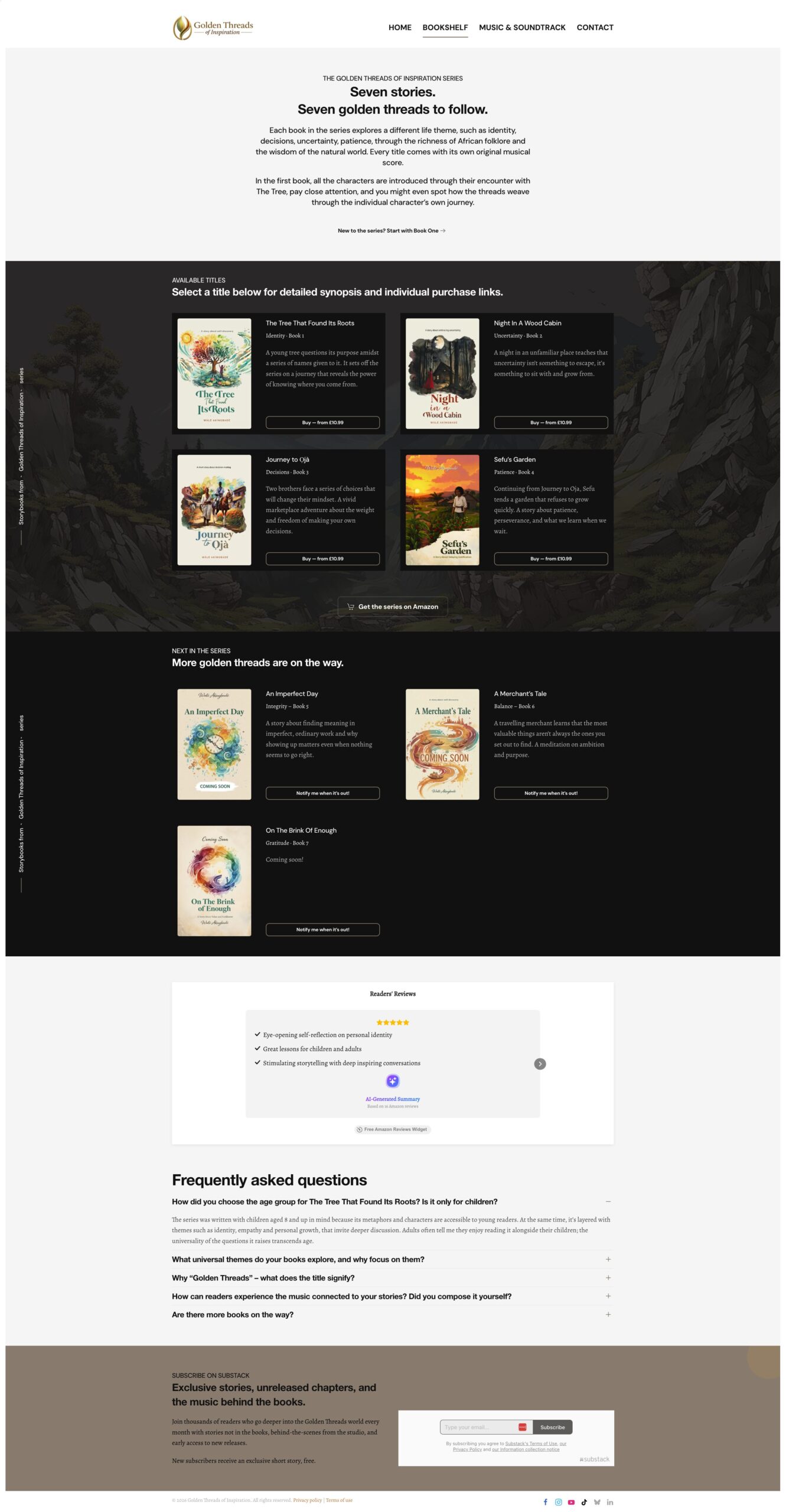
We built the website as the homing point. Each book has its own page with the cover, the theme, and buy buttons routing straight to Amazon. Each soundtrack links directly to the streaming platforms. The whole collection is visible from every doorway, so a visitor arriving for one book leaves knowing there are seven, each with its own music.
The Substack newsletter is woven through the site as the audience asset, welcoming new subscribers with a free exclusive story, so casual discovery converts into a relationship the series owns. Reviews from families and classrooms provide the reassurance parents and teachers look for, and the author’s story gives the series the voice no product listing could carry.
What changed,
and what it means
The series now has a centre. Discovery on any channel leads to the full world, purchases route through the checkouts readers already trust, and between releases the newsletter keeps the audience close, so each new book launches to a readership instead of an algorithm. The channels stopped competing for the audience and started feeding it.
What this project teaches
beyond this project
These are the four lessons we would put in front of any business owner or stakeholder facing a similar challenge.
1. Multichannel without a hub is permanent introduction
Platforms show slices, never the whole. A brand selling through marketplaces and streaming services needs one place it owns where the full offer is visible, or every customer meets only the fragment the algorithm happened to show them.
2. Route to strength, do not rebuild it
The temptation is to sell direct and stream on-site. But Amazon’s checkout and Spotify’s player already hold the customer’s trust and payment details, and competing with them adds friction that costs sales. Let the platforms do what they are best at, and let the hub do the one thing they never will: tell the whole story.
3. The audience you own is the one you can launch to
Reach on rented platforms resets with every algorithm change. A newsletter list is the only channel where the brand decides who hears the news, which is why the welcome gift, a free exclusive story, is not a giveaway but an asset purchase.
4. Write for your least technical reader and you lose nobody
The site had to work for an eight-year-old, a busy parent, and a teacher between lessons. Writing that plainly did not cost sophistication, it removed the friction for everyone. Accessible language is a conversion tool disguised as a courtesy.
Where do all your
channels meet?
If your products, content, and audience live on platforms you do not own, a homing point turns scattered discovery into a following. Tell us where your customers find you today and we will map the hub.
No commitment · Responds within 24 hours · London GMT · Global projects welcome