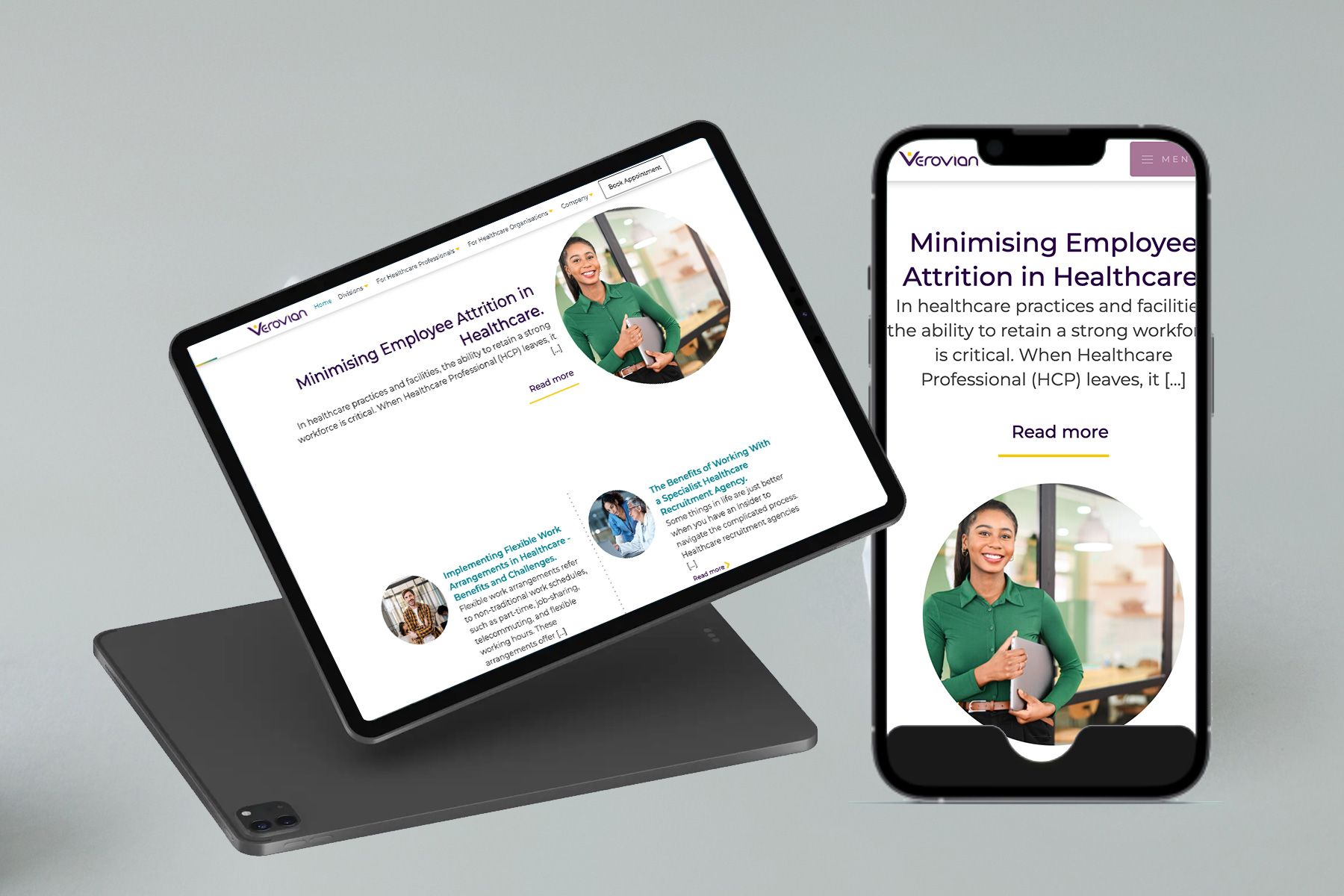
Verovian: rebuilding a healthcare staffing platform for scale.
A staffing platform serves two customers at once: the organisations that need people and the professionals who fill the shifts. This is how a growing locum agency got a platform that serves both from one home, doubled its enquiries, and cut its admin by 85 percent.
Growth had outrun
the platform
Verovian places locum healthcare professionals, from pharmacists to nurses and beyond, with the practices, pharmacies, and organisations that need them. The agency itself was thriving. Its platform was not keeping up: the old site tried to speak to hirers and professionals in the same breath, and the operational work behind every registration and placement was still being done by hand.
That combination is common in growing agencies, and it is quietly expensive. Confused visitors leave without enquiring, and every manual step behind the scenes means growth arrives with an admin bill attached.
Three problems,
stated plainly
We write the problems down before we design anything. If a proposed solution does not answer at least one of them directly, it does not make the build.
Hirers and professionals shared one journey
A pharmacy manager looking to cover a shift and a locum looking for work arrived at the same pages and read the same words. Neither felt spoken to, both had to work out where to go, and every moment of confusion cost enquiries from each side.
Every registration meant manual work
Sign-ups, details, and placement information were collected loosely and processed by people. The team spent its days re-keying, chasing, and coordinating, which is work that produces no revenue and grows with every new registrant.
Every new division was a rebuild
The agency serves multiple healthcare disciplines, and the old structure had no repeatable pattern for them. Expanding into a new discipline or region meant reworking the site rather than extending it, so the platform punished the agency for growing.
Qualifying solutions
before applying them
We researched the two audiences separately, because they are different people with different pressures. Hirers are managers with a gap in tomorrow’s rota, acting under time pressure and needing confidence fast. Professionals are clinicians deciding who deserves their career details, needing clarity on how registration and placement actually work. We mapped both journeys end to end and noted every point where the old platform made either of them think.
On the operations side, we audited the admin itself: what the team did with each registration and booking, how long it took, and how much of it was the same every time. The share that was routine and repeatable became the automation target, because user experience and good ergonomics apply behind the counter as much as in front of it.
Solutions were qualified against firm criteria: each audience had to be routed to its own journey within seconds of arriving, registration had to capture structured information that systems could act on without re-keying, and the platform pattern had to extend to a new discipline or region as configuration rather than a rebuild.
Route the audiences,
structure the intake
The rebuilt platform separates the two journeys at the front door. Hirers and professionals each get their own clearly signposted path, written in their own language, with the reassurance each needs before committing. Neither audience reads a word meant for the other.
Behind the journeys, registration and enquiry became structured self-serve flows. Information arrives complete and organised instead of scattered across emails, so the routine processing that once filled the team’s days largely handles itself. And the whole platform is built on a repeatable pattern, so a new discipline or region is a matter of extending the structure rather than redesigning it.
What changed,
and what it means
Enquiries doubled once each audience had a journey that spoke to them, and the admin behind registrations and placements fell by 85 percent, returning the team’s time to the relationships and placements that actually grow the agency. The platform now scales with the business instead of against it, with new disciplines onboarding into an established pattern.
What this project teaches
beyond this project
These are the four lessons we would put in front of any business owner or stakeholder facing a similar challenge.
1. Serve two audiences by separating them, not blending them
When a platform must serve buyers and suppliers, the instinct is to write copy that covers both. The result speaks to neither. Routing each audience to its own journey within seconds, in its own language, is the single change that most reliably lifts conversion on dual-sided platforms.
2. A structured form is a member of staff
The difference between a loose enquiry and a structured intake flow is the difference between creating admin and completing it. Every field that arrives organised is a task nobody has to do. Businesses drowning in coordination work should look at their forms before they look at their headcount.
3. Time-poor users reward plain language
Clinicians and managers between shifts do not browse, they scan. Plain words, obvious next steps, and reassurance placed exactly where doubt arises turned visits into enquiries. Writing simply is not dumbing down, it is respecting the reader’s minute.
4. Build the pattern, then repeat it
The rebuild’s lasting value is the repeatable structure underneath it. Because every discipline follows the same pattern, growth became configuration. Stakeholders planning a platform should ask what adding the next service line will involve, and reject any answer that sounds like a project.
Serving two audiences
from one front door?
Buyers and suppliers, hirers and talent, clients and partners. If both arrive at the same pages and neither feels spoken to, you are losing enquiries from each side. Tell us who you serve and we will map the journeys.
No commitment · Responds within 24 hours · London GMT · Global projects welcome