NEOCR: what it takes to turn a bricks and mortar business digital.
Most businesses do not need an app or custom software to transform. They need the right proven tools, connected properly, with automation applied where the time actually goes. This is the story of how a traditional property business became a scalable digital operation, and what any business owner can take from it.
A healthy business,
carrying hidden costs
NEOCR LTD lets short-term properties across London and is developing a mixed-use building in the North East. By every traditional measure the business worked: good properties, good guests, good reviews. But like thousands of small property businesses, its digital operation had grown by accident rather than design. Bookings arrived through third-party platforms. Availability lived in more than one calendar. Guest communication was typed by hand, message by message.
None of these things looked like a crisis on any given day. Together, they set a ceiling on the business. Commission left with every booking, admin grew with every property, and the team’s time was spent servicing the system instead of the guests. The engagement began with a simple question: what would this business look like if the digital side worked as hard as the people do?
Four problems,
stated plainly
Before designing anything, we wrote the problems down as testable statements. If a proposed solution did not answer at least one of them directly, it did not make the build. This discipline shaped every decision that followed.
Every booking paid a middleman
The business had no direct booking route, so every stay carried platform commission and every guest relationship belonged to someone else’s database. The business could not offer its best rate, and it could not speak to its own guests before they booked.
Availability lived in more than one place
With calendars split across channels, every booking created a manual update somewhere else, and every manual update was a chance to miss one. The worst-case outcome, two guests holding the same nights, was not a possibility but a matter of time.
Every guest question stopped the team
Check-in instructions, directions, mid-stay questions, and check-out reminders were all typed by hand. The messages were near-identical every time, yet each one interrupted real work, and guests messaging at night waited until morning for answers.
Every new property meant more of everything
With a development pipeline on the way, the existing way of working would multiply. Twice the properties meant twice the calendars, twice the messages, twice the admin. Growth was about to make the business harder to run, which is growth working against you.
Qualifying solutions
before applying them
We never start with tools. We start inside the business. Before anything was designed, we spent time in the operation itself: tracking where the team’s hours actually went across a working week, mapping the complete guest journey from the first search to check-out, and sitting with the business stakeholders to understand what “easy to run” genuinely means for the people who would live with the result every day.
That research surfaced something that shaped everything after it. This platform had two sets of users, not one. The guest booking a stay is the obvious user, but the owners and the operations team are users too, and their experience of the system matters just as much. User experience and good ergonomics sit at the cornerstone of how we work, and that applies to the back office as fully as it does to the booking page. A system that delights guests but exhausts the team is a failed system.
From the research we set four qualification criteria, and every candidate solution had to pass all of them before it earned a place. It had to answer at least one of the problem statements directly. It had to be operable by a non-technical team with no developer on standby. It had to draw from and maintain a single source of truth for availability. And it had to scale to the next property as a setup task rather than a project. Solutions that could not clear that bar, however impressive, did not make the build.
Orchestrate proven tools,
do not build from scratch
The most important decision in this engagement was what not to build. A custom booking engine, a custom messaging system, or a custom channel manager would each have cost more than the entire project and left the client dependent on developers forever. Instead, we designed the solution as an orchestration: the right proven online tools, each doing the one job it is best at, connected so they behave as a single platform.
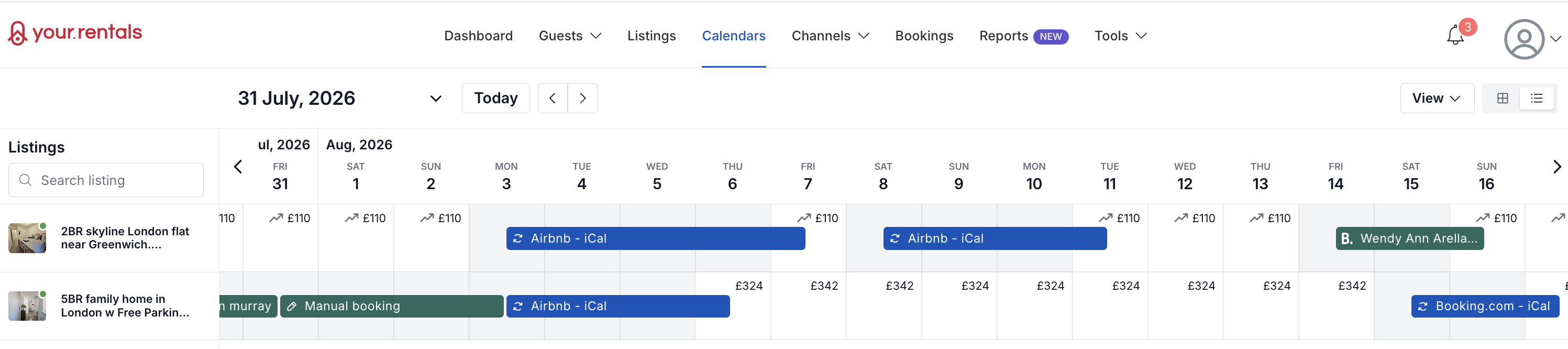
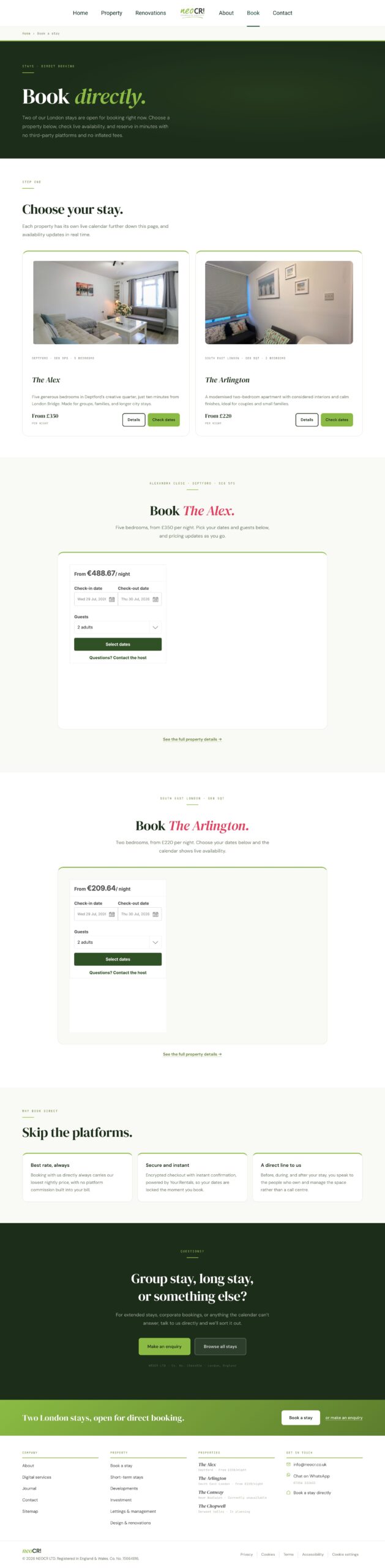
An accessible, booking-first website became the front door, with each property given its own page, gallery, and live calendar, and every screen shaped by what the guest research told us people look for before they commit. The Your.Rentals short-let management platform became the single source of truth for availability and pricing, syncing the website’s direct booking calendars with every connected third-party channel in real time. A messaging layer was configured around guest segments, so a weekend visitor, a family, and an extended-stay guest each receive a different automated journey from confirmation to check-out. And AI was put to work in the background, drafting guest communications and invoices, maintaining listing content, and strengthening the local search and GEO signals that make the properties the answer when nearby search engines and AI assistants are asked.
The team’s experience received the same design attention as the guest’s. Availability lives in one view, the daily workflows take fewer steps than the manual routines they replaced, and nothing in the system needs technical knowledge to operate, because a platform the team finds awkward is a platform the team will eventually work around. Each layer answers a numbered problem. Direct booking answers the commission problem. The channel sync answers fragmented truth. Segmented automation answers manual communication. And because the whole platform is configuration rather than code, onboarding the next property is a setup task, not a project, which answers linear admin growth.
What changed,
and what it means
Guests now book directly at any hour, at rates better than the platforms can offer, and the guest relationship belongs to the business from the first click. The team runs one calendar that stays accurate everywhere, so the double-booking risk is not reduced but removed. Just as importantly, the system is comfortable to run: the daily picture sits on one screen, and the people using it needed no technical training to take it over. Routine guest communication runs itself, with the team stepping in only where a human genuinely adds value. And the platform is ready for the development pipeline: each new unit at the North East project will plug into the same system on day one, with no new admin burden attached.
What this project teaches
beyond this project
Every engagement leaves lessons that outlast it. These are the six we would put in front of any business owner or stakeholder weighing up a digital transformation of their own.
1. Transformation is orchestration, not invention
The instinct is to assume digital transformation means building software. In practice, almost every capability a small or mid-sized business needs already exists as a proven tool. The value is in choosing the right ones, connecting them properly, and configuring them around how the business actually works. Orchestration costs a fraction of custom development, ships in weeks rather than months, and leaves the client owning a system anyone can maintain.
2. Establish one source of truth before automating anything
Automation built on fragmented data automates the errors along with the work. The channel integration came before the messaging automation for a reason: once availability had a single source of truth, everything downstream could trust it. Any business considering automation should ask first where its one true record lives, whether that is a calendar, a stock level, or a client list, and fix that before automating a single message.
3. Automate the routine, keep humans for judgement
The goal was never to remove people from guest relationships. It was to remove people from the ninety percent of messages that are identical every time, so their attention is available for the ten percent that genuinely need a human. Segmenting guests into different automated journeys kept the communication personal in substance, not just in name. The same principle applies to any customer-facing business: automate the predictable, and the human moments get better, not fewer.
4. Own the direct channel, even while using the platforms
Third-party platforms are valuable for reach, and the integration keeps them fully in play. But a business that only exists on platforms rents its own customers. Building the direct channel alongside them means every marketing pound, every review, and every returning guest now compounds into an asset the business owns. For any business selling through marketplaces, aggregators, or agencies, the question is the same: where do your customers land when they come looking for you by name?
5. Design for the next one on day one
Scalability is a decision made at the start, not a feature added later. Because every property page, calendar, and messaging journey follows the same repeatable pattern, growth is a setup task rather than a rebuild. The stakeholder question that surfaces this early is simple: when the second location, product, or service arrives, what will adding it actually involve? If the honest answer is “another project”, the architecture is wrong.
6. The back office is a user experience too
Digital transformation succeeds or fails on adoption, and adoption is decided by ergonomics. If the people running the business find the new system harder than the old habits, they will quietly route around it and the old chaos returns. Designing the operator’s experience with the same care as the customer’s, fewer screens, fewer clicks, no jargon, is not a nice-to-have. It is the difference between a transformation that sticks and one that fades. Ask the people who will run the system what a good day looks like, then design for that.
Which of those four problems
sounds like yours?
Commission leaking away, calendars that disagree, messages typed by hand, or growth that multiplies your admin. If any of them sounded familiar, the fix is closer and more affordable than you might expect. Tell us how your business runs today, and we will map what orchestration could do for it.
No commitment · Responds within 24 hours · London GMT · Global projects welcome